Professors: Request an Exam Copy
Print copies available for US orders only. For orders outside the US, see our international distributors.
Second Edition
Foreword by: James V. Hoffman
Publication Date: June 26, 2026
Pages: 272
Series: Research and Practice in Social Studies Series
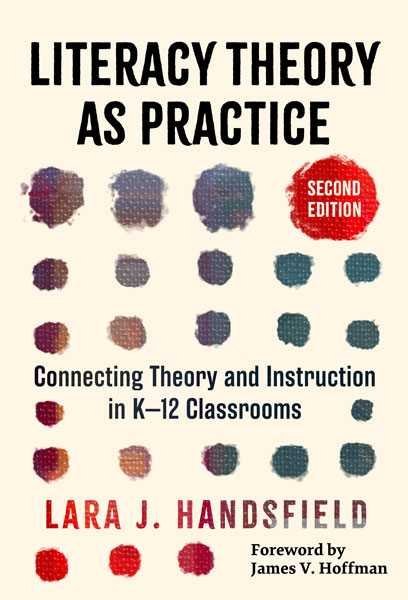
This is both a comprehensive overview of major theoretical developments in literacy AND a teaching guide with in-depth classroom examples of how literacy can be used in daily classroom practice.
In this expanded and completely updated second edition, Handsfield introduces the most influential theories and models of reading and literacy—from cognitive and information-processing theories that underpin foundational skills to social constructionist and critical theories that support socially just instructional practices in today’s post-digital landscape. Focusing on how these theories connect with different curricular approaches (K–12), the book shows how they both shape and are shaped by everyday literacy practices in classrooms.
Readers will find detailed vignettes of classroom practice explored from various theoretical standpoints, illuminating how theory is brought to life in the classroom. Substantial attention is devoted to multilingual classrooms and communities, engaging with current sociopolitical issues in literacy curricula, and literacy teaching in the post-digital age. Chapters contain key questions for further exploration and user-friendly inset discussions that explore complex terminology and connect literacy theory to current debates and world events.
New for the Second Edition!
Lara J. Handsfield is professor emerita of elementary literacy and bilingual education in the School of Teaching and Learning at Illinois State University.
“Dr. Handsfield challenges us to examine the emerging literacy practices of children and youth, as well as the literacy practices of teachers as theories in action. . . . As you engage with the practices surfaced in this book, you embark on a path of professional growth.”
—From the Foreword by James V. Hoffman, professor emeritus, The University of Texas at Austin
“Divisions created by complex social and political factors in our global world have a powerful influence on teaching and learning and leave educators searching for resources to acquire the fundamental knowledge needed to mobilize and create educational changes in literacy instruction. This timely text is an essential resource for those responsible for making sound decisions based upon an informed understanding of literacy theories, educational practices, and the multiplicity of diverse students in today’s K–12 classrooms.”
—Doris Walker-Dalhouse, professor, Marquette University and coauthor, Equitable Literacy Instruction for Students in Poverty
“Literacy Theory as Practice opens with a striking irony: This book on theory is a ‘homage to classroom practice.’ As Handsfield reports, ‘theory is made to be used’ by teachers in the service of children’s learning. This refreshing approach is much needed at a time when teaching is increasingly scripted and teachers are often dismissed as knowledgeable and committed professionals. Through clear definitions and illustrative examples, the book makes theory both understandable and practical. Updated with rich insights related to COVID-19, attacks on DEI, the affordances and risks of ChatGPT, and concerns about the current dominance of narrow approaches to teaching reading, this text invites practitioners and scholars to recognize, explore, and realize the practical importance of useful theories.”
—Catherine Compton-Lilly, John C. Hungerpiller Professor, Coordinator, Teaching and Learning PhD Program, University of South Carolina
Professors: Request an Exam Copy
Print copies available for US orders only. For orders outside the US, see our international distributors.