
Professors: Request an Exam Copy
Print copies available for US orders only. For orders outside the US, see our international distributors.
Edited by: Mike Kuczala, Lynne Kenney
Foreword by: Cindy Hovington
Afterword by: Ronald S. Fischler
Publication Date: February 27, 2026
Pages: 240
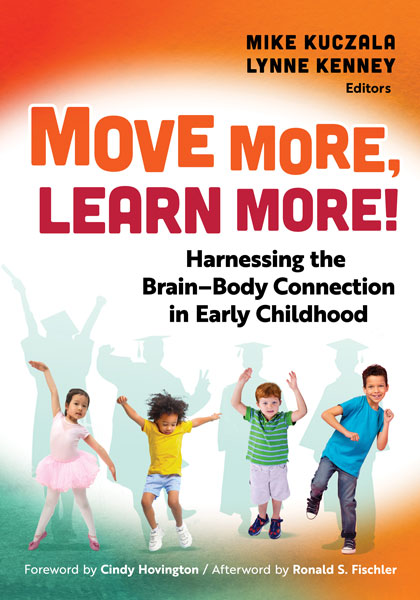
This book shares how movement is deeply connected to early learning, offering 50+ activities that focus on young children’s growth and development.
Young children don't just move to develop their bodies—they move to develop their brains. Move More, Learn More! demonstrates the profound connection between physical activity and early childhood development through cutting-edge research from neuroscience, developmental psychology, and exercise science. This groundbreaking book teaches how movement fundamentally shapes brain architecture during the early years, building the neurological foundations essential for cognitive growth, academic success, and social-relational well-being.
Move More, Learn More! bridges the gap between research and practice, offering evidence-based insights in every chapter. By understanding how developmental skills emerge from shared neurological pathways, Pre-K –3rd grade educators can transform their approach to early learning. Educators and clinicians will discover immediately applicable strategies to help children develop healthy brains and bodies during these formative years.
This first-of-its-kind resource will empower readers to harness the transformative power of movement, showing not just what happens when children are physically active, but why it matters so deeply for their development and how to maximize these benefits in educational settings.
Book Features:
Mike Kuczala is a keynote speaker, professional development facilitator, president of Kuczala Consulting, and chief executive officer for Regional Training Center. Lynne Kenney is an international educator, researcher, and a pediatric psychologist on the language and cognition team at Wellington-Alexander Center for the Treatment of Dyslexia, Scottsdale, Arizona.
“The combined wisdom in this book beautifully affirms what I’ve witnessed and championed for over 40 years: The brain and body are not separate entities, and children need movement to learn, to grow, and to thrive. If this book doesn't convince educators that movement is a must, I'm not sure what will.”
—Rae Pica, early childhood education consultant and author of Why Play? How to Make Play an Essential Part of Early Education
“Move More, Learn More! is an essential resource that powerfully reveals the foundational impact of movement on brain development, learning, and well-being in early childhood. Internationally known movement experts provide the scientific evidence, brain-based theory, and practical activities to intentionally integrate movement that significantly improves children's cognitive, social, and academic success. This book is a must-have for educators, clinicians, and parents.”
—Jean Moize, internationally known educational consultant and founder of Action Based Learning
“Move More, Learn More! is a powerful and practical resource that bridges neuroscience and real-world application. The authors clearly show that movement, rhythm, and play are essential for learning, regulation, and growth—important for all young children, especially those with developmental delays and disorders. A must-read for educators, clinicians, and parents dedicated to helping every child reach their full potential.”
—Mary Barbera, autism mom, behavior analyst, and bestselling author of Turn Autism Around: An Action Guide for Parents of Young Children with Early Signs of Autism
Contents
Foreword: Why Movement Matters: What Every Teacher, Clinician, and Parent Should Know About Children’s Brains Cindy Hovington v
Acknowledgments vii
Introduction 1
Mike Kuczala
Part I: What to Know
1. Light a Fire! The Scientific Basis for Integrating Movement Into School and Clinical Settings 7
Lynne Kenney, United States
2. Physical Activity, Neuroplasticity, and Brain Growth: The Key Connections 20
Ty Melillo, United States
3. Enhancing Sensory-Motor, Cognitive, and Social Skills in Young Children Through Physical Activity 32
Joann McFee, Kelly Barnhart, and Lynne Kenney, United States
4. Using Music Interventions to Strengthen Cognition, Co-regulation, and Self-Regulation: The Pre-K SEND Program 51
Angelo Molino with Lynne Kenney, United States
Part II: What to Do (Academic Development)
5. Implementing Cognitive-Physical Activities to Strengthen Executive Function Skills for Better Learning and Behavior 67
Lynne Kenney with Mike Kuczala, United States
6. Using Movement and Music to Enhance Language and Reading Skills in Young Children 92
Stacy Fretheim, United States
7. Handwriting and Movement: Addressing Delays and Difficulties 109
Mary Mountstephen, UK
8. Activity Gym and Cross-Body Activities for Children 126
Piero Crispiani and Eleonora Palmieri, Italy
9. The Kinesthetic Classroom: Teaching and Learning Through Movement 141
Mike Kuczala, United States
Part III: What to Do (Self-Regulation and Social-Relational Development)
10. Rhythm and Movement for Early Childhood Self-Regulation Development 153
Kate Williams, Australia
11. “MovementWorks” for Neurotypical and Neurodivergent Learners 167
Ali Golding, UK
12. Promoting Social Connections Through Group Activities 186
Andy Milne, United States
13. Creating Meaningful Movement Experiences Before, During, and After School 198
Andy Vasily, Belgium
Conclusion: Putting It All Together So Kids Will Move More to Learn More 211
Mike Kuczala, United States
Afterword: The Pediatric Perspective of the Family Experience and Why Returning to Our Roots in Pediatrics Matters for Children Ronald S. Fischler 215
Index 217
About the Editors and Contributors 226
Professors: Request an Exam Copy
Print copies available for US orders only. For orders outside the US, see our international distributors.