
Professors: Request an Exam Copy
Print copies available for US orders only. For orders outside the US, see our international distributors.
Edited by: Laura Mahalingappa, Hayriye Kayi-Aydar, Nihat Polat
Publication Date: March 27, 2026
Pages: 272
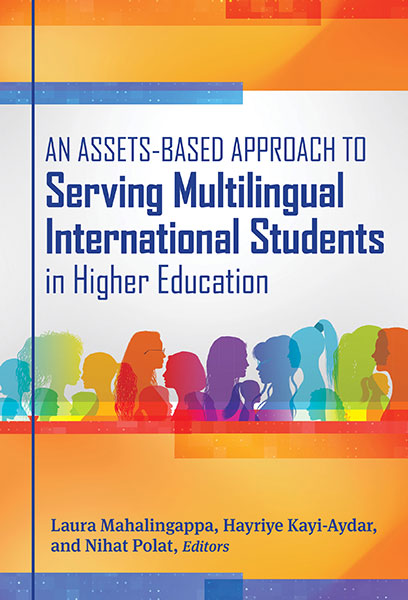
This guide will help higher education institutions create a more purposeful and supportive learning and cultural environment for their multilingual international students.
Through a lens of equity and social justice, this volume offers a comprehensive look at the education of multilingual international students (MISs) in higher education. Featuring contributions from leading scholars, this collection tackles issues of inequity in admissions, language testing, mentoring, mental health, and more. It provides critical insights into the diverse experiences of MISs on multilingual and multicultural campuses, along with evidence-based practices and policy recommendations. As universities increasingly recruit international students, this book will help a wide range of professionals to address the specific linguistic, academic, and sociocultural needs of this student population.
Book Features:
Laura Mahalingappa is an associate professor of applied linguistics and language education at the University of Maryland. Hayriye Kayi-Aydar is a professor of English applied linguistics/TESOL at the University of Arizona. Nihat Polat is a professor and chair of the Department of Teaching and Learning, Policy and Leadership at the University of Maryland.
“This much-needed book provides a comprehensive guide for higher education professionals serving multilingual international students in undergraduate or graduate programs. The authors provide concepts and ideas to establish a more supportive learning environment for this student population. This important collection addresses relevant topics within the Teaching English to Speakers of Other Languages (TESOL) field.”
—Luciana C. de Oliveira, professor, Department of Teaching and Learning, Virginia Commonwealth University
“Anyone working with multilingual international students (MISs) will find this book to be an invaluable resource. It educates stakeholders across university campuses on how best to help MISs succeed through creating equitable learning spaces and supportive relationships. Perhaps more important, it underscores the need to recognize these students’ diverse experiences and broad range of competences as assets rather than impediments to their success, showing how their contributions to university communities benefit everyone.”
—Elizabeth R. Miller, professor of applied linguistics, University of North Carolina at Charlotte
“This is a timely volume about the all-important population of international students in the United States. It brings together a wealth of topics, from equity and pluralism to academic needs for writing and oral communication, to wellness and trauma. It succeeds admirably in stimulating critical thinking at the policy level. A must-read for anyone doing higher education!”
—Lourdes Ortega, professor, Georgetown University
“This is a much-needed resource for faculty who want to better meet the linguistic, academic, and socio-emotional needs of this often-overlooked segment of the student population.”
—Peter De Costa, professor, Michigan State University
“As the executive director of a Fulbright commission, which encourages international students to enroll in U.S. universities, I am delighted to promote An Assets-Based Approach to Serving Multilingual International Students in Higher Education. These essays by leading experts in pedagogy and curriculum design are a timely celebration of the value and importance of international students. They persuasively demonstrate that embracing the linguistic and intellectual wealth of multicultural experience more accurately reflects both the realities of global academic mobility and the moral and intellectual commitments of higher education institutions. By forefronting these values with evidence-based research, this volume reaffirms the core strengths of American higher education at its best.”
—Randall L. Nadeau, executive director, Foundation for Scholarly Exchange (Fulbright Taiwan)
“Kudos! This volume addresses a critical need, as the numbers of multilingual international students continue to increase in U.S. universities. Chapter authors bring their expertise in teaching multilingual learners to the higher education context, drawing on a range of different asset-based frameworks to offer tools, practices, and orientations for effective instruction.”
—Deborah Palmer, professor and chair, Equity, Bilingualism, and Biliteracy, BUENO Center for Multicultural Education, University of Colorado Boulder
Professors: Request an Exam Copy
Print copies available for US orders only. For orders outside the US, see our international distributors.